
Share Adrian Ruyle's obituary with others.
Invite friends and family to read the obituary and add memories.
Stay updated
We'll notify you when service details or new memories are added.
You're now following this obituary
We'll email you when there are updates.
Select your format and elements to print

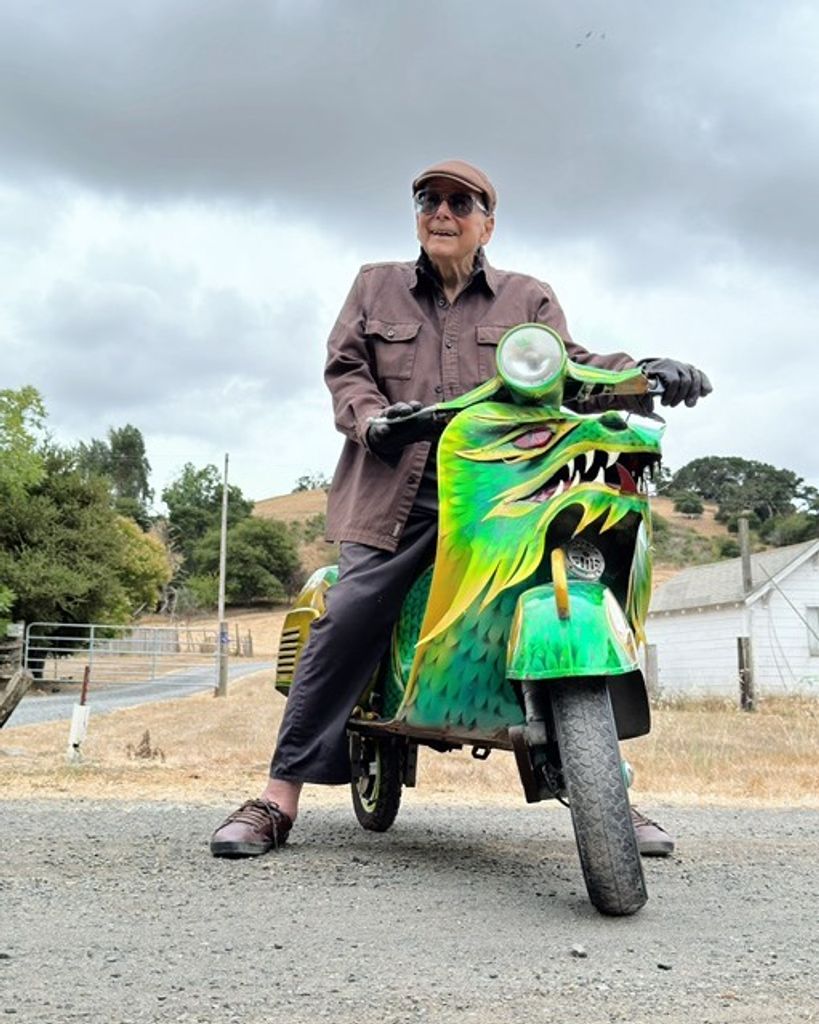


Adrian Ruyle
Dec 13, 1932 — Oct 19, 2026
Petaluma, California
A research mathematician who became an artist and spent more than forty years painting and sculpting on the San Francisco waterfront.
From the Ivy League in Boston to the San Francisco waterfront, Adrian Ruyle—a former research mathematician—lived the life of a working artist for more than forty years. On a pier overlooking the bay, he painted and sculpted while classical music filled the studio, whether from the radio or from the grand piano played by Adrian himself or by visiting musicians.
His 5,000-square-foot waterfront studio became as much a work of art as the pieces created within it. The chandeliers were his own creations. A glass-enclosed office overlooked the workspace, while a lush garden of Cymbidium orchids flourished on the stringer facing McCovey Cove, plainly visible from the Lefty O'Doul Bridge. Adrian believed that to create beauty, one should live and work surrounded by beauty.
He was widely admired for his remarkable ability to capture a likeness with extraordinary precision, whether in pen and ink or with an airbrush using automotive paint. His subjects ranged from intimate portraits to seven-foot canvases and even the sides of vans. In the 1990s, the San Francisco Bay Guardian named him "Best Automotive Artist"—an especially fitting honor for a man who had once exhibited an Alvis automobile at Pebble Beach. Alvis, the British automobile manufacturer based in Coventry, England, built cars from 1919 to 1967.
Adrian was one of the original artists selected for the Hearts of San Francisco public art project benefiting San Francisco General Hospital. His Rose for Remembrance is featured in the commemorative book published for the event. His cartoons earned awards from the Comic Art Museum in San Francisco during the 1990s, and he later self-published four graphic novels. Like his parents, three brothers, two sisters, and a nephew, Adrian attended the University of California, Berkeley. Although he was drawn to architecture, mathematics offered greater career opportunities in the 1950s, and he earned his degree in mathematics.
After graduation, he was drafted into the United States Army. While stationed in Verdun, France, he became a certified instructor and directed the Battalion Troop Information and Education Program before using the G.I. Bill to pursue graduate studies. He went on to a successful career as a research mathematician in Lincoln, Massachusetts, working first at Harvard and later at MIT. During the formative years of modern computing, he also represented his institution through the Association for Computing Machinery at national conferences.
Everything changed when he returned to the San Francisco Bay Area in the early 1970s. Leaving mathematics and computing behind, he followed the work of his heart and established Adrian Studios at Pier 46, at the foot of Second Street, on the site now occupied by Oracle Park.
Over the following decades he created paintings, sculptures, cartoons, and graphic novels while becoming one of the Bay Area's most sought-after custom automotive artists. His 1966 Volkswagen Beetle, painted with scenes from Wagner's Ring Cycle, was featured in the local press and exhibited at art-car events and in film. An antique Vespa transformed into a green dragon was displayed at the California State Fair. Whether driving one of his art cars, riding the Dragon Vespa or one of his art bicycles, or wearing one of his hand-painted leather jackets celebrating feminine beauty, Adrian was instantly recognizable.
His portraits—particularly his celebrated series of women gracefully veiled by flowers— combined technical mastery with a profound appreciation for the female form. Fellow artists and collectors alike admired his exceptional gift for likeness.
The legendary burlesque performer Tempest Storm remarked that Adrian had made her look "like a Vargas girl," comparing his airbrush mastery to the celebrated illustrations of Alberto Vargas.
His work is held in numerous private collections and includes commissioned portraits, pen-and- ink drawings depicting historic San Francisco, paintings of local landmarks, and works on reclaimed wood executed with automotive paint and airbrush.
When construction of the San Francisco Giants' ballpark displaced Pier 46 in 1996, Adrian Studios relocated to Pier 26 beneath the Bay Bridge for the next decade. In 2006 he moved to Petaluma, California, where he revived his computing skills to create digital paintings that received awards at the Sonoma County Fair and entered private collections.
Adrian buried a son, Patrick McKenzie Ruyle, who died of cancer in 2020.
He is survived by his companion of forty-one years, Margory Cohen and their beloved Scottish Deerhounds, his brother Eugene and his sons Jordan and Jonathan Ruyle, numerous nieces and nephews; Jim Reeve, Susan Harloe, Pat Mayer, Jan Morgan, Chris Morgan and Aaron Ruyle.
Adrian will be remembered with love and gratitude by family, friends, fellow artists, and all who enjoyed his company. His charm, wit, style, loyal friendship, boundless curiosity, and wide-ranging intellect made him unforgettable. Whether at an art opening, an art-car gathering, a dinner party, or over coffee in a neighborhood café, conversation with Adrian was invariably lively, thoughtful, and inspiring.
His work lives on in the collections he created, in the people whose lives he enriched, and in the beauty he believed should surround us all.
Guestbook
Visits: 27
This site is protected by reCAPTCHA and the
Google Privacy Policy and Terms of Service apply.
Service map data © OpenStreetMap contributors